01 Multi-armed Bandit
Summary of Chapter 2 of Sutton and Barto
Stationary k-armed Bandit Problem
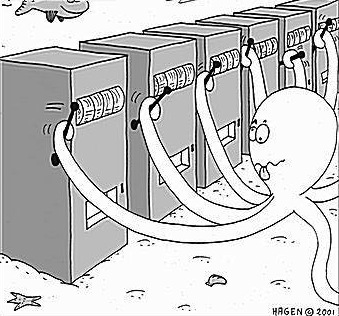
In any reinforcement learning problem, at any time step t, an agent selects an action $A_t$ from the list of all possible actions and receives a reward $R_t$ from the environment.
In case of stationary k-armed bandit problem, at any time step t, the agent must select one of the k-arms $A_t$, hence there are k-choices (actions) and receives a reward $R_t$ which is sampled from a stationary probability distribution $R(a)$.
The objective of multi-arm bandit problem is to maximize the expected reward over some given number of time steps T.
\[\text{} \mathop{\max} \mathop{\mathbb{E}}[R_1 + R_2 + \cdots + R_T]\]Value of action
At time step t, let $A_t$ be the action taken and $R_t$ be corresponding reward. Then, the value of an arbitary action $a$ is:
\[q_*(a) \doteq \mathop{\mathbb{E}}[R_t | A_t = a]\]$q_*(a)$ is an unknown quantity. We denote the estimate by $Q_t(a)$.
\[\text{want } Q_t(a) \text{ close to } q_*(a)\]This estimate is used to select an action which may give us better rewards.
Action-value methods
Two important steps of any reinforcement learning problem is to:
- Estimation of $Q_t(a)$
- Selection of actions
A simple way to estimate $\forall a \in A, Q_t(a)$ is to progressively maintain average rewards received by action.
\[Q_t(a) \doteq \frac{\sum_{t=1}^{T-1} R_t \cdot \mathop{\mathbb{I}\{A_t = a\}}}{\sum_{t=1}^{T-1}\cdot \mathop{\mathbb{I}\{A_t = a\}}}\]Where numerator term is total reward when 'a' taken prior to 't' and denominator term is number of times 'a' taken prior to 't'. When denominator is zero we assign some default value.
Given an estimate $Q_t(a)$, a greedy selection can be made as follows:
\[A_t \doteq \argmax_a Q_t(a)\]Exploration-and-Exploitation: For a better solution there has to be a balance between how much the agent exploits his current knowledge and how much it should explore. With only exploitation, it will not explore other options which can potentially give better rewards in long run. With only exploration, the agent is ever-exploring without using his accumulated knowledge to select an action which gives better reward compared to other actions.
The balance between exploitation and exploration becomes prominent in a non-stationary action-reward distribution.
Unfortunately, the greedy approach often performs poor. It always exploits current knowledge to maximize immediate reward. It ignores exploring other actions which may possibly give better results in future. Hence, a better way is to have a parameter $0\lt\epsilon\lt1$ which is the probability of exploration.
Therefore, with probability $\epsilon$ the agents selects an action randomly (exploration) and with probability $1-\epsilon$ agent performs a greedy choice.
\[A_t \doteq \begin{cases} X & \text{w.p. $\epsilon$} \\ \argmax_a Q_t(a) & \text{w.p. $1-\epsilon$} \end{cases}\]where $X$ is random variable with a uniform probability over the action set.
Incremental Implementation
$Q_n(a)$ is the estimate of value of action $a$ after it has been selected $n-1$ times.
\[\begin{align*} Q_n(a) & \doteq \frac{R_1 + R_2 + \cdot + R_{n-1}}{n-1} \\ Q_{n+1}(a) &= \frac{1}{n} \sum_{i=1}^{n}R_i \\ &= \frac{1}{n} \left(R_n + \sum_{i=1}^{n-1}R_i \right) \\ &= \frac{1}{n} \left(R_n + (n-1)Q_n \right) \end{align*}\] \[\begin{equation*} \boxed{Q_{n+1}(a) = Q_n + \frac{1}{n} \left[R_n - Q_n \right]} \end{equation*}\]This equation can be interpreted as:
\[\begin{equation*} NewEstimate \leftarrow OldEstimate + StepSize \left[Target - OldEstimate \right] \end{equation*}\]where $Target - OldEstimate$ is the error in previous estimate.
Non-stationary Reward Distribution
In a non-stationary action-reward distribution setting more importance should be given to recent rewards for the estimation of $Q_t(a)$. A simple way to achieve that is to use constant step-size $0\lt\alpha\lt1$.
\[\begin{equation*} Q_{n+1} \doteq Q_n + \alpha \left[R_n - Q_n \right] \end{equation*}\]This is called exponential recency-weight average.
The step-size can be varied for interesting results for eg., in previous problem it was $\alpha_n(a) = \frac{1}{N(a)} = \frac{1}{n}$
From stochastic approximation theory convergence with probability of 1 is assured if the following conditions are met:
\[\begin{align*} \sum_{n=1}^{\infty} \alpha_n(a) = \infty \\ \sum_{n=1}^{\infty} \alpha_n^{2}(a) \lt \infty \end{align*}\]The first condition is to ensure that the steps are large enough to eventually overcome initial condition or random fluctuations. The second condition ensures that eventually steps become small enough to assure convergence.
For a non-stationary problem a non-converging $\alpha$ is desirable, such that the estimates never converge and continue to vary in response to recent rewards.
With a constant $0\lt\alpha\lt1$ the estimates desn’t converge, whereas with $\alpha_n(a) = \frac{1}{n}$ the estimate converges.
Upper Confidence Bound Action Selection
The $\epsilon-$greedy method:
\[\begin{align*} A_t \doteq \begin{cases} X & \text{w.p. $\epsilon$} \\ \argmax_a Q_t(a) & \text{w.p. $1-\epsilon$} \end{cases} \\ X \sim \text {uniform distribution over action set} \end{align*}\]Can we combine exploration and exploitation through a single quantity? In addition to that, in our present exploration method we are randomly selecting an action assuming a uniform distribution, which can be improved by taking in account the realtive potential of action actually being optimal.
\[\begin{align*} A_t \doteq \argmax_a \left[Q_t(a) + c \sqrt{\frac{\ln t}{N_t(a)}} \right] \end{align*}\]where $N_t(a)$ is number of times action $a$ has been selected prior to time step $t$.
The second term (square root term) is uncertainity (or variance) in estimate of $Q_t(a)$. It make sures that all actions are first explored atleast once before a greedy choice is made.